Average Reviews:

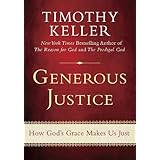
(More customer reviews)Are you looking to buy Generous Justice: How God's Grace Makes Us Just? Here is the right place to find the great deals. we can offer discounts of up to 90% on Generous Justice: How God's Grace Makes Us Just. Check out the link below:
>> Click Here to See Compare Prices and Get the Best Offers
Generous Justice: How God's Grace Makes Us Just ReviewWhen I ordered Timothy Keller's "Generous Justice," I thought I was buying a book about God's justice (in condemning sinners), which has been assailed by so many recently. Never have I been so pleasantly and emotionally surprised by a book. What Keller has done instead is to wed a theology of God's grace to us, and one that is fully orthodox in nature, with a biblical emphasis on social justice. Keller's main thesis is this: God's "generous justice" to humans who are poor in spirit and in great need is a motivation for our administering social justice - as well as an evidence that we have truly received the grace of God.This is truly a mind-blowing, heart-rending thesis - and it's hit me like a ton of bricks! The very night I read this book, I read (from the Book of Common Prayer) the prayer for Social Justice in our Evening Prayer service at church. Obviously God is trying to teach me something, and I think He's trying to teach you all the same thing. That something is that Christians are to be involved in social justice not only because it's a commandment but because it's a response to a life that's received the grace of God (His "generous justice").
Keller cuts across the great conservative/liberal divide in this book. He has something that most of you will at first disagree about, but when you truly consider it, you'll find that he's probably right. Social justice is about caring for the poor and alienated, both as individuals and as communities. To conservative Christians he preaches that social justice does indeed involve changing entire communities and that real oppression and social injustice still exists in the U.S. To liberal Christians he preaches that much of poverty really does come from the personal moral failings of individuals. In fact, he outlines 3 possible causes of poverty: oppression, calamity, and personal moral failure. He believes that the biblical emphasis is especially on the larger structural factors (although I don't necessarily agree with him here.)
Perhaps most importantly, Keller is putting his money where his mouth is: his Redeemer Presbyterian Church is located in Manhattan.
What Keller does best, beginning with the Old Testament and continuing through the teachings of Jesus and the Epistles is to show God's concern for social justice. You cannot read this book without being challenged to want to be more involved in correcting social injustice, whether at the individual or social level. This book hit me like a ton of bricks because years ago I had read Ron Sider's Rich Christians in an Age of Hunger while in college. I was originally moved by the book but then became aware that Sider had made a lot of errors in his theology and thinking. For years, I allowed this and the liberal emphasis on the social gospel as opposed to the true gospel to shield me from the biblical message of the need for justice.
This book has been like a sledgehammer to my soul, and it will take me months and years to sort out what God would have me do next.
In addition to providing the biblical and theological rationale for caring for the poor and disadvantaged, Keller turns towards a more practical approach towards the end of the book, which was exactly what I needed. He answers questions I and many others have, such as "What if I don't live by an area of poverty?" (then look for the disadvantaged, abused, neglected, sick, single parents wherever you are!) He discusses 3 levels of help that need to be offered: relief (direct aid to immediate needs), development (giving a family or community what they need to move beyond dependency), and social reform (changing the conditions and social conditions that cause dependency).
Keller divides his book up this way:
Introduction: Why Write This Book?
Chapter One - What is Doing Justice?
Chapter Two - Justice and the Old Testament
Chapter Three - What Did Jesus Say About Justice?
Chapter Four - Justice and Your Neighbor
Chapter Five - Why Should We Do Justice?
Chapter Six - How Should We Do Justice?
Chapter Seven - Doing Justice in the Public Square
Chapter Eight - Peace, Beauty, and Justice
There are still things I disagree with about the book, and I have a few areas where I think Keller could have been clearer or more forceful so as not to mislead.
My 1st objection is that Keller seems to emphasize justice in terms of structures more than the justice we seek for individuals (for example, the many ways I seek justice among my kids at home). Keller didn't talk about this side of things enough. He also, in my opinion, doesn't adequately take into account the moral failings that are the cause of so much of American poverty since the 20th century. It's not that he isn't aware of this side of things: I just think he understates it.
Second, while Keller's clearly aware that our contemporary situation is not a theocracy like that of ancient Israel, too much of the time he seems to assume that the social justice we seek is out in the world at large, as opposed to the social justice we seek specifically in the Church. The New Testament letters are clearly more heavily weighted toward how we seek justice specifically in the Church, which is to model social justice for the world, even as the justice of national Israel was to be a model for the nations. He also doesn't address the problem that in ancient Israel and the first century Church, Christians knew who the poor were because there was little social mobility. They knew who was really lame and who was faking; they knew who had fallen on hard times; and they knew who was merely lazy or malicious. It's much more difficult for Christians today to discern this, and Keller makes no (or at least inadequate) reference to the traditional Christian distinction between the deserving and the undeserving poor (an issue that several books by George Grant discuss more adequately).
In spite of these errors or exaggerations, "Generous Justice" is still a book every church should be discussing. Read it, and see if it doesn't break your heart and make you more aware of God's grace to you, as well as your need to do justice to those around you!
Generous Justice: How God's Grace Makes Us Just Overview
Want to learn more information about Generous Justice: How God's Grace Makes Us Just?
>> Click Here to See All Customer Reviews & Ratings Now

0 comments:
Post a Comment